Buy-to-let arrears are half the owner-occupier rate. Here is what that does, and does not, tell you.

Buy-to-let mortgages fell into arrears at 0.44% in Q2 2026 against 0.89% for homeowner mortgages. What that comparison proves, and what it does not.

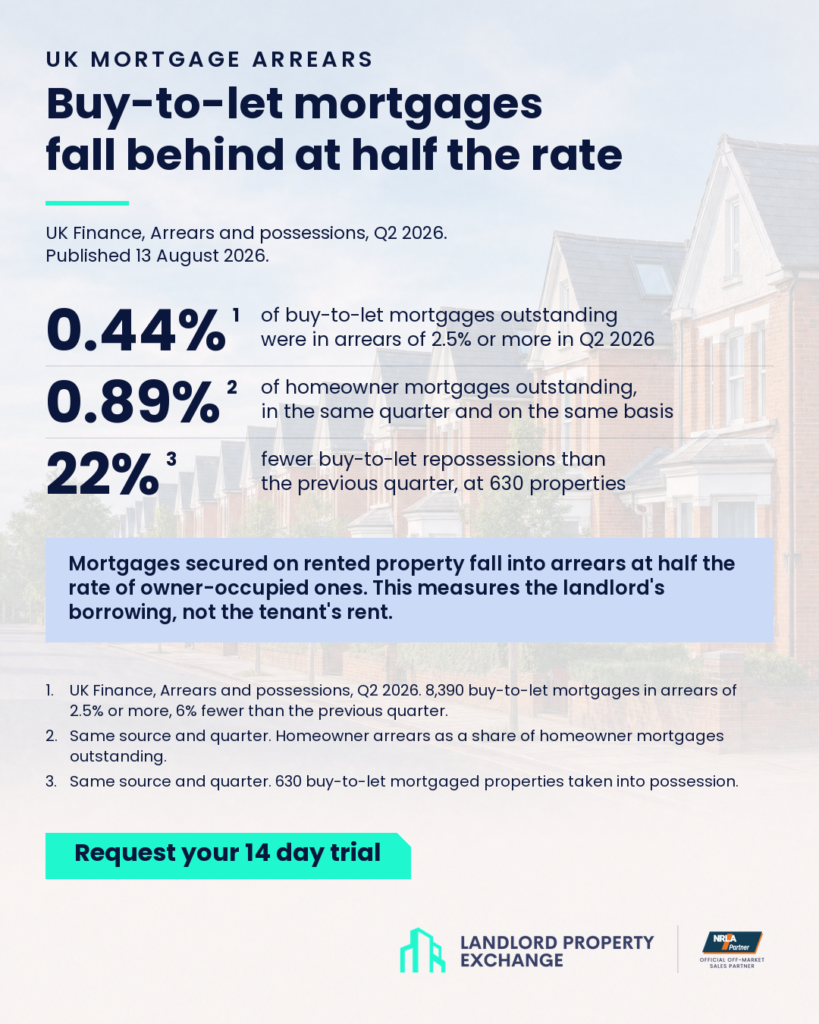
Infographic titled UK mortgage arrears. Headline: buy-to-let mortgages fall behind at half the rate. Three figures, each with its own definition. 0.44% of buy-to-let mortgages outstanding were in arrears of 2.5% or more in Q2 2026. 0.89% of homeowner mortgages outstanding, in the same quarter and on the same basis. 22% fewer buy-to-let repossessions than the previous quarter, at 630 properties. A panel reads: mortgages secured on rented property fall into arrears at half the rate of owner-occupied ones. This measures the landlord's borrowing, not the tenant's rent. Source line: UK Finance, Arrears and possessions, Q2 2026, published 13 August 2026. A call to action reads: Request your 14 day trial. LP Exchange and NRLA logos.

Table of contents

The first question almost everyone asks about buying a property with a tenant already in it is what happens if that tenant stops paying. It is the right question to ask, and there is official quarterly data that speaks to it directly.

That data is more reassuring than most buyers expect. It is also narrower than the headline makes it sound, and the gap between those two things is worth more to you than the numbers are.

The stock this data describes is not on the portals

Tenanted property, sold landlord to landlord, with the income running and the tenancy intact.

Request your 14 day trial

What the two numbers actually are

Two groups of borrowers, both measured by UK Finance, both in the second quarter of 2026, both against the same threshold of arrears worth 2.5% or more of the outstanding mortgage balance.

The first group is mortgages secured on rented property. The second is mortgages secured on the borrower’s own home. In that quarter, arrears accounted for 0.44% of all buy-to-let mortgages outstanding, against 0.89% of all homeowner mortgages (UK Finance, Arrears and possessions, published 13 August 2026).

So the rate on rented property was slightly under half the rate on owner-occupied property. Same quarter, same organisation, same definition of arrears on both sides. That last point is the one that makes the comparison worth printing at all, because a comparison drawn from two different periods or two different thresholds tells you nothing except that somebody wanted a headline.

Both sides of this comparison are counted the same way, in the same quarter, by the same organisation. That is what makes it a comparison rather than a coincidence.

What the comparison does not say, and this is the important part

It does not say that tenants pay more reliably than homeowners.

The figure describes the credit performance of mortgages secured on rented property. That is the landlord’s borrowing, not the tenant’s rent. A buy-to-let borrower and an owner-occupier borrower are two different populations of people, borrowing against two different kinds of asset, for two different reasons. The data compares how those two groups of borrowers service their own debt.

Anyone who writes this figure up as “tenants are twice as reliable as homeowners” has written something the source does not support. We are not going to do that, because a buyer who acts on a claim that falls apart under one question is a buyer we have made worse off.

What it does support is narrower and still useful. Lending secured on rented property is, at portfolio level, performing better than lending secured on owner-occupied property, and it has been doing so while every headline about the private rented sector has pointed the other way.

This figure describes the landlord’s borrowing. It does not describe the tenant’s rent. Those are different questions and only one of them has official quarterly data behind it.

The direction of travel, which is the other half of the picture

A single-quarter rate is a snapshot. The movement underneath it says more.

In the same release, 8,390 buy-to-let mortgages were in arrears of 2.5% or more, which is 6% fewer than the previous quarter, and 630 buy-to-let mortgaged properties were taken into possession, 22% fewer than the previous quarter (UK Finance, Arrears and possessions, published 13 August 2026).

Both measures moved down in the same three months. Neither is a forecast and UK Finance does not offer one, but a falling arrears count alongside a sharply falling possession count is not the shape of a sector in distress, whatever the coverage of it has looked like this year.

See the payment records, not the rental estimates

Every listing carries the tenancy, the rent and the yield before you enquire.

Request your 14 day trial

Fewer buy-to-let mortgages in arrears, and fewer taken into possession, in the same three months.

So what does answer the tenant question?

Honestly, no official quarterly release does. The closest thing to a measure of tenant payment behaviour is landlords being asked about their own portfolios, which is a survey rather than a count.

The most recent of those, from Paragon Bank, Q2 2026, reports that 26% of landlords had experienced arrears in their portfolio, down from 30%. Treat that differently from the figures above. It is one lender’s own research, reported through the trade press, and we have not been able to reach a primary copy of it. It moves in the same direction as the official data, which is worth knowing, and it is not evidence of the same weight.

That distinction is the whole point of this article. A tenanted property is not risk-free and nobody should sell it to you as though it were. What it is, is a property whose income has a history rather than a projection, and a history is something you can actually examine before you commit.

An empty property comes with a rental estimate. A tenanted one comes with a payment record.

What this changes if you are buying

Three practical shifts, none of which depend on reading the arrears figure as more than it is.

Ask for the payment record, not the rental valuation. On a tenanted purchase the rent is an observed fact with a length of tenancy behind it. That is a different and better class of information than a letting agent’s estimate on a vacant flat, and it is the thing to ask for first.

Price the handover, not just the yield. The transactions that go wrong on tenanted stock rarely go wrong on the rent. They go wrong on deposit protection, on missing paperwork, on a tenancy nobody documented properly. Those are diligence items, and they are findable in advance.

Stop treating “tenant in situ” as the risk column. The sector-level data says the borrowing behind rented property is performing better than the borrowing behind owner-occupied property, and it says so in the same quarter and on the same measure. That is not a reason to skip your own checks. It is a reason to stop applying a risk premium that the aggregate data does not support.

James Donohue, who founded LP Exchange, described one landlord-to-landlord sale on LinkedIn in February 2026 as “exactly the type of transaction that protects tenants, maintains income continuity, and creates a win-win outcome for all involved”. That is the shape of the market this data describes: income that keeps running through a change of owner, rather than an asset that has to be emptied before it can be sold.

The part most buyers get stuck on

You can accept every word above and still not be able to act on it, because tenanted stock is overwhelmingly not on the portals. Landlords selling a working, income-producing property generally do not want a public listing, a sign outside, or their tenant reading about it online.

That is the market LP Exchange exists to open up. We are the official off-market property sales partner of the NRLA, the UK’s largest landlord association, with over 110,000 members, and the tenanted property that changes hands through us does so landlord to landlord, with the income continuing and the tenancy intact.

Ready to look at tenanted stock?

Full access to the off-market tenanted listings, for your first 14 days.

Request your 14 day trial

Frequently asked questions

Are buy-to-let mortgages more likely to fall into arrears than residential ones?

No. In Q2 2026, arrears accounted for 0.44% of all buy-to-let mortgages outstanding, against 0.89% of all homeowner mortgages (UK Finance, Arrears and possessions, published 13 August 2026). Both are measured against arrears of 2.5% or more of the outstanding balance, in the same quarter.

Does that mean tenants pay more reliably than homeowners?

No, and the figure cannot be read that way. It measures the credit performance of mortgages secured on rented property, which is the landlord’s borrowing rather than the tenant’s rent. The two are separate questions and the official data only answers the first.

Are buy-to-let repossessions rising?

Not in the most recent quarter. UK Finance reported 630 buy-to-let mortgaged properties taken into possession in Q2 2026, 22% fewer than the previous quarter.

Is a tenanted property riskier to buy than an empty one?

It carries different risks rather than more of them. The income is already observed rather than estimated, so the rent is easier to verify. The diligence shifts onto the tenancy paperwork, deposit protection and compliance history, all of which can be checked before exchange.

Where do these figures come from?

UK Finance, Arrears and possessions, published 13 August 2026, covering the second quarter of 2026, read directly from ukfinance.org.uk.

The arrears data describes stock you cannot see

Every figure on this page comes from mortgages already being paid. The tenanted properties behind them rarely reach the portals, because they sell landlord to landlord with the tenancy intact. LP Exchange is where that stock changes hands, with the payment history, the tenancy paperwork and the rent already stated on the listing.

Request your 14 day trial