Buying a tenanted property: the documents to ask for before you commit
Buying a tenanted property? A housing litigation partner's list of what to fix before selling is your due diligence: six checks, and what each one proves.
8 August 2026
Table of contents
Before buying a tenanted property, ask for six things: any notice already served and under which ground, the written tenancy agreement, the statement of terms, the deposit paperwork, the current safety certificates, and a straight answer on which of those you will actually receive. Each one tells you something the asking price cannot.
What are you actually buying when a property has tenants?
You are buying an income stream that already exists, on terms somebody else agreed, with paperwork somebody else did or did not complete. The building can be surveyed. The tenancy behind it cannot, and it is the tenancy that decides whether the income is enforceable. That is the part buying a tenanted property turns on.
The question got sharper on 1 May 2026, when the Renters' Rights Act was introduced. It changed what a landlord must have in place, and because a tenancy transfers with the property, it changed what a buyer inherits. The government's own Guide to the Renters' Rights Act sets out the regime.
Melanie Saunders is a partner in housing litigation at Primas Law, which is where these documents finally get tested, usually years after somebody decided not to ask for one. Speaking at the London Evening Exchange, she took a room of landlords through what to fix before selling. She was coaching sellers. Read the same list from the other side of the table and it is a buyer's due diligence checklist, written by somebody with no stake in the sale completing.
“So it's really, just making sure that it's doing absolutely everything that you should do.”
Melanie Saunders, Partner, Housing Litigation, Primas Law
Which documents should you ask for before you buy a tenanted property?
Six, and in this order: any notice served and under which ground, the written tenancy agreement, the statement of terms, the deposit protection paperwork, the current gas safety record and EICR, and a direct answer on which of those you will actually receive. The first one moves the most money.
1. Has any notice been served, and under which ground?
This is the check that moves money, which is why it comes first. Section 21 is abolished, so a landlord seeking possession to sell now needs Ground 1A under Section 8, which requires four months' notice. Once Ground 1A has been used, the property cannot be re-let for a full 12 months, even if it does not sell.
Read that as a buyer. If the ground was used before you bought, you may be acquiring an income asset that is not permitted to produce income for the rest of that year. It is the single largest gap between what a tenanted listing appears to be worth and what it will actually pay. We cover the mechanism in full in Ground 1A explained, and the change it replaced in what Section 21 abolition means.
Melanie also flagged the notices that no longer work at all:
“anything that you should not be doing, such as serving a section 21 notice or a notice to quit after the 1st of May because we all know they're not going to be valid.”
So there are two answers to get in writing. Has notice been served? And if so, under what ground and on what date?
“Once Ground 1A has been used the property cannot be re-let for a full year. That is not a paperwork detail. That is a year of the yield you are being sold.”
LP Exchange, resting on Selling a Property Portfolio in 2026, page 08.
2. Is the tenancy in writing?
Ask for the tenancy agreement itself, not a summary of it. An oral tenancy is a real tenancy, and it is also one where nobody can prove what was agreed. If you buy it, you are the person who will have to prove it later, and the agreement is the document every other document refers back to.
Melanie's guidance to the landlords in the room was direct:
“So, for example, if you only have oral tenancies, and I can't imagine that many of you will probably only do that. But if you don't, you need to make sure that you issue them with a new tenancy agreement.”
3. Has the statement of terms been issued, and when?
Ask both halves of that question. The statement of terms is the written record of what the tenant has actually been told, and Melanie tied it to a specific date: it should be issued from 1 May for existing tenancies. A statement served late is a different position from one served on time, and the difference only surfaces when somebody needs to rely on it.
“to make sure that your statement of terms is issued from the 1st of May for existing tenancies”
4. Is the deposit protected, and is the paperwork right?
Ask for three fields: the scheme, the reference and the date the prescribed information was served. Deposit protection is one of the few areas here where the consequence is mechanical rather than arguable, and the government sets out the landlord's duties in deposit protection schemes and landlords.
Melanie's point to the room was that where a deposit has been taken, the position has to be right in relation to the deposit requirements. If those three fields cannot be produced, you have learned something useful for free.
5. Are the safety certificates current and dated?
Ask for the gas safety record and the EICR themselves, not confirmation that they exist. The date is the whole point of asking. A certificate that expired four months ago tells you something about the property, and it tells you rather more about how the property has been run. The HSE sets out the landlord's gas safety duties, and the electrical safety standards guidance covers the EICR.
6. Which of these will you actually receive, and when?
This is the honest question, and it separates a real process from a polished one. At LP Exchange we request EICR documents, floorplans, gas safety records where applicable and AST documents up front. We do not receive all of them on every listing. We gather as much as we can before a property goes live, and the rest can be requested at the interest or offer stage, which is when it goes to legals and when it matters most.
So the useful question to put to a seller or an agent is not “is this property compliant”. It is “which of these six do you hold today, and which are you requesting”. A straight answer to that is worth more than a reassuring one.
Civil penalties can now reach up to £40,000 (LP Exchange, Selling a Property Portfolio in 2026, page 03). That is the maximum civil penalty now available to local authorities under the Renters' Rights Act. It is not a transaction cost you can price into an offer, because it is not charged at the point of sale. It lands later, on whoever holds the property.
That is the argument for doing this before you commit rather than at the legal stage. The paperwork is cheap to check and expensive to inherit.
“The paperwork is cheap to check and expensive to inherit.”
How does LP Exchange handle this on its own listings?
LP Exchange is an off-market platform for buying and selling tenanted property, and the official off-market property sales partner of the NRLA, the UK's largest landlord association, with over 110,000 members. Because the platform is built around tenanted property, the six checks above are the normal shape of a deal here rather than an edge case.
So we ask sellers for the documents before a listing goes live, and document status is surfaced upfront, where sellers provide them.
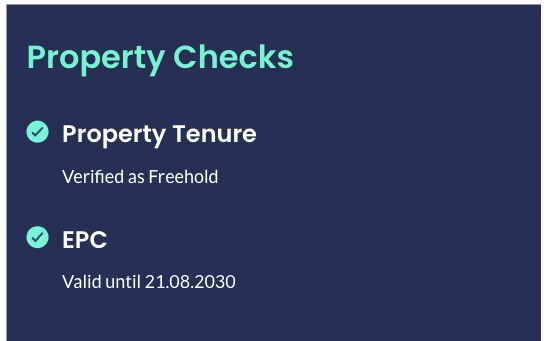
On a listing in the member app you see the tenancy status, the rent and the region before you speak to anyone, alongside a property checks panel showing the status of what has been provided. What we do not tell you is that the checking is finished. We tell you what we hold, and the remainder is requested at the interest or offer stage.
That is the practical difference this makes to the six questions above. You are not starting them from zero on a phone call. You are starting them from what is already on the listing, and spending the call on the gaps.
If you are on the other side of this and thinking about selling tenanted stock, the same list is what your buyer will ask you for, and our guide to selling a property portfolio covers that route.
Common questions about buying a tenanted property
Can I still buy a property where a Section 21 notice was served?
Section 21 is abolished, so a notice served after 1 May 2026 will not be valid. What matters is whether possession was pursued under Ground 1A instead, and on what date. Ask for the ground and the date in writing before you offer.
How long does Ground 1A take?
Ground 1A requires four months' notice. After it has been used, the property cannot be re-let for a full 12 months, even if it does not sell (LP Exchange, Selling a Property Portfolio in 2026, page 08).
Does the tenancy transfer to me when I buy?
Yes. Buying with tenants in situ means the tenancy transfers with the building, which is why the tenancy paperwork forms part of what you are buying rather than an administrative afterthought.
What if the seller does not have all six documents?
That is common, and it rarely means walking away. It means knowing before you offer rather than after. Ask which documents exist today and which are being requested.
Is a written tenancy agreement legally required?
An oral tenancy can be valid. The practical problem is evidential: if the terms are not written down, the person who has to prove them later is whoever owns the property at the time.
Melanie's last point to the room was about selling:
“looking to then sell those assets at some point, at exactly what your buyer will be looking for.”
She was telling landlords to get their paperwork into the shape a buyer will want. You are that buyer. The list is already written. Ask for it.
This is not legal advice. LP Exchange is not a law firm and is not a tax adviser. Melanie Saunders' comments were made at a live event and are reproduced as recorded in the film's own captions. Always seek independent legal advice on a specific transaction.
Start with the six questions already answered
Membership gives you the listings where these six questions are the normal shape of a deal, with the tenancy status, the rent, the region and the document status on the listing before you speak to anyone. If you want a wider view of the market first, our complete investor guide to buying tenanted property covers how the rest of the assessment fits together.