
Tenant fraud is rising. Here is the buyer’s read.

77% of UK landlords say tenant fraud is more common than three years ago. Here is the buyer's read: why a running tenancy is a different risk to a promise.

Two adjacent brick houses in bright daylight: one lived in with open curtains and a bicycle by the door, one empty with an overgrown path

Table of contents

77% of UK landlords say tenant fraud is more common than it was three years ago. That finding comes from LegalforLandlords’ research published on 28 July 2026, a survey of 1,034 UK landlords, and most of the coverage has read it one way: a warning to landlords about who they let to.

There is a second reading, and it matters more if you are buying. The survey is not really about bad tenants. It is about the limits of prediction: how little an application form can tell you about how a tenancy will behave. And that has a direct consequence for how investors buy.

What the research found

The headline figures from the LegalforLandlords survey:

  • 77% of landlords say tenant fraud is more common than three years ago
  • 1 in 10 have experienced it directly
  • 24% of those cases cost £5,000 or more
  • 34% involved deliberate non-payment, with misleading information supplied on the application form

That last figure describes the mechanism. In a third of cases the fraud worked not by defeating the checks but by feeding them, because an application is, structurally, a set of promises. References can be selective. Circumstances change the week after they are checked. A form describes a person at their most presentable, then the tenancy begins and the description stops mattering.

Referencing remains essential. Its limit is just worth naming plainly: it sees the story a stranger tells you. It cannot see behaviour, because there is no behaviour yet. All four figures above are from LegalforLandlords’ July 2026 release, which carries the detail behind them.

Where the risk actually lives

Strip the survey to its mechanism and it says this: the riskiest moment in the rental cycle is the moment a property meets a stranger. Every void resets the landlord to that moment. New applicant, new promises, new unknowns.

Now look at the same mechanism from a buyer’s chair. When you buy a vacant property to let, you inherit that exact moment: your first act as an owner is to trust an application form. Your projected yield rests on a tenancy that does not exist yet, at a rent nobody has ever paid, from a tenant nobody has ever observed.

There is a cost dimension too, and it needs no dramatising. A void is not only missed rent. It is marketing the tenancy, referencing again, and carrying the property while you stand inside the exact uncertainty this research measures, at your own expense, until somebody moves in. Each of those steps is a cost you either price in at purchase or discover afterwards.

A tenanted purchase begins at the opposite end. The tenancy is not a projection. It is running, and it has a record.

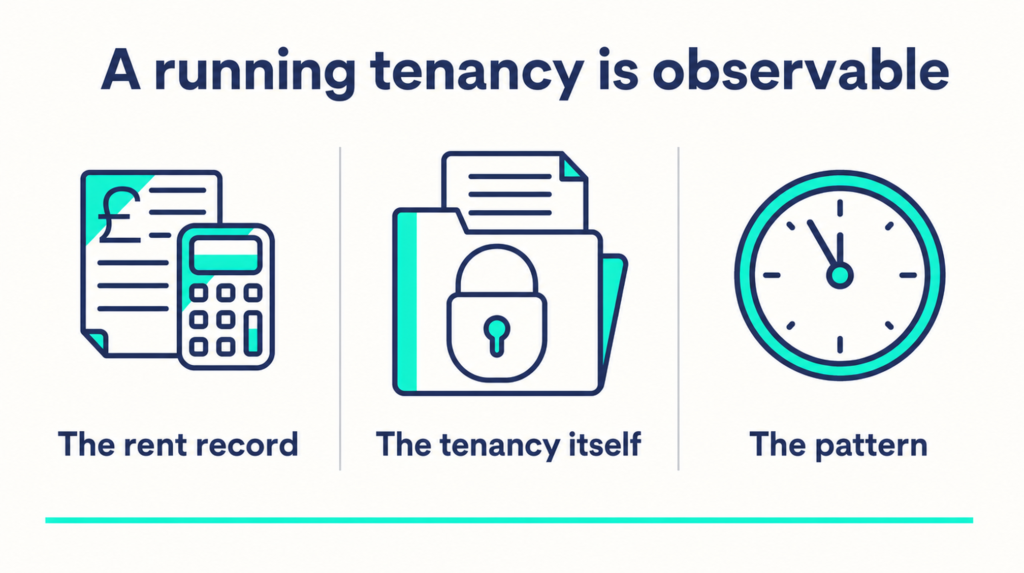
Diagram: a running tenancy is observable through the rent record, the tenancy itself and the pattern

A running tenancy is observable

This is the distinction the fraud statistics make valuable. You cannot vet a stranger’s promises, but you can observe an existing tenancy, because evidence of it exists in the ordinary paperwork of the transaction:

  • The rent record. Whether rent has been paid, and for how long, is evidenced in diligence through your solicitor, not asserted in an advert.
  • The tenancy itself. The agreement, its terms and its dates sit in the legal pack your conveyancer reviews before you exchange.
  • The pattern. A tenancy that has run for years at a consistent rent is a track record. A projection is not.

No purchase is risk-free, and an existing tenancy carries its own questions: the terms you inherit, and the relationship you step into. The difference is that these are questions with evidence attached.

In practice the sequence is unglamorous, which is rather the point. Your solicitor raises the standard enquiries on a tenanted sale; the seller’s side produces the tenancy agreement, the deposit details and the rent history; and you read what an application form could never have shown you, which is how this specific tenancy has actually behaved. Anything in the record that needs explaining gets explained before exchange, not discovered after completion.

How LP Exchange states it

This logic is built into how opportunities are presented on LP Exchange. Every listing states its current tenant status, alongside the rent, the asking price, the gross yield and the region: each opportunity carries its own figures, never a portfolio average. Each property also carries its Property Checks record, listing the verifications completed on that property.

The result is that the question this research raises, what do I actually know about the tenancy I am taking on, has a stated answer before you commit your time. Not a promise. A record. If the diligence habits described above are how you already buy, the platform will feel familiar, because it is built to put those answers first.

The platform lists tenanted investment opportunities off-market, landlord to landlord, as the official off-market property sales partner of the NRLA. Members see every live opportunity with the numbers stated, and the first 14 days of access are free: we review every request, and our team contacts you within 1 business day.

Selling side, reading this from the other chair: a running tenancy is not an obstacle to your sale. To the right buyer it is the value. Here is how a tenanted, off-market sale works.

This is not legal advice.

See the tenancy before you buy it

Every LP Exchange listing shows the rent being paid, the tenancy position and the figures behind the yield, so you can assess a property on its record rather than on a forecast.

Request your 14 day trial