
Five questions to answer before you sell a tenanted property

Most tenanted sales are decided before the property is discussed. Five questions that shape a clean, discreet exit, and why each one matters.

An open blank notebook, fountain pen and cup of tea on a desk beside a sunlit window overlooking rooftops

Table of contents

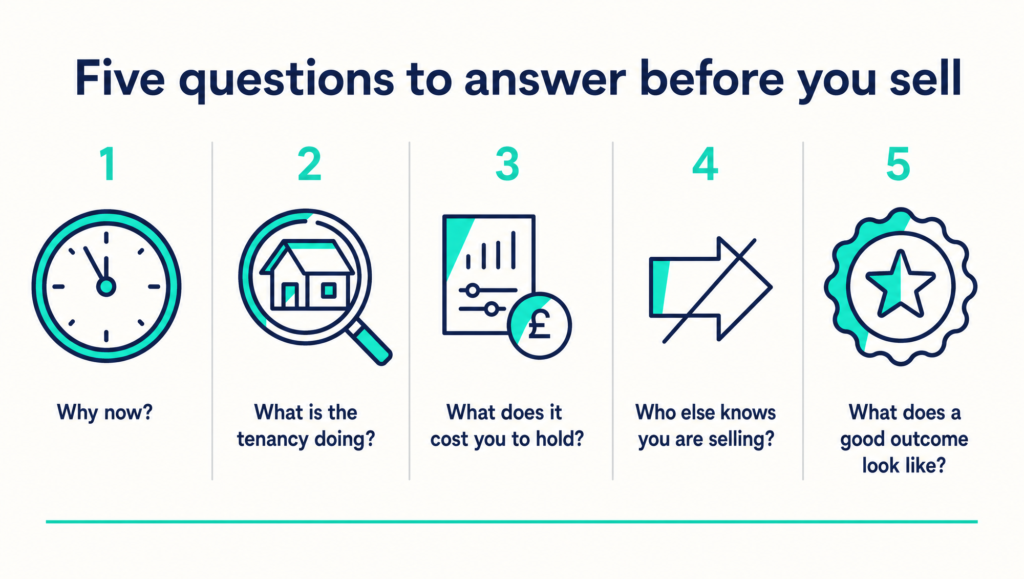
The five questions to answer before you sell a tenanted property: why now, what the tenancy is doing, what it costs you to hold, who else knows you are selling, and what a good outcome looks like.

Most selling conversations start with the property: what it is, where it is, what it might fetch. The conversations that end well usually start somewhere else. When a landlord talks to our team about selling, we ask five questions before we ask anything about the building, because the answers shape the timeline, the structure and the buyer far more than the specification does.

Here are the five, and why each one matters to a clean exit.

1. Why now?

Not a challenge, and never a negotiating tactic. The reason behind a sale sets every term that follows. Retirement after decades points one way: the outcome matters more than the pace. A portfolio being rebalanced points another: the proceeds have a destination, and probably a date. Costs that have crept past the rent point somewhere else again.

None of these reasons is better than another. But each implies a different timeline, a different appetite for negotiation and a different definition of done. A sale planned around its real reason tends to hold together under pressure. A sale planned around an asking price tends to wobble the first time the process tests it.

2. What is the tenancy doing?

Is the rent being paid, and for how long has it been? How settled is the tenancy? What terms does it run on, and is the paperwork in order?

This question matters because of what the answer is worth. A performing tenancy is not a complication to be explained away before a sale can happen. To the right buyer it is the value: income from day one, and a track record where a vacant property offers only a projection. The open market trains sellers to assume a tenant in place narrows the field. Sold landlord to landlord, the opposite is true, and the buyers who understand that are exactly the ones worth being in front of.

If the record has gaps, that is worth knowing now rather than mid-transaction. It does not need to be perfect. It needs to be understood, so it can be presented honestly and dealt with before it becomes a surprise.

3. What does it cost you to hold?

The mortgage, the compliance calendar, the next certificate due, the management time nobody invoices you for. Most landlords can feel this number. Fewer have written it down.

Write it down. When holding costs more than it returns, that is information, not failure. It tells you what a good outcome has to beat, and it turns “should I sell?” from a mood into a comparison. It also protects you from the opposite mistake: selling a property that is quietly doing its job because a headline made holding feel worse than it is.

4. Who else knows you are selling?

Often the honest answer is nobody, and the landlord would like to keep it that way. That preference is not squeamishness. A public listing announces the decision to your tenants, to neighbouring landlords and to the whole open market at once, and it invites viewings and speculation into a tenancy that is still running.

Discretion protects more than comfort. Tenants who learn of a sale from a portal advert often start planning their own move, and the income the sale is built on becomes less certain in the exact months it matters most. An off-market sale keeps the decision private: no board, no listing, no interruption to the tenancy. The people who know are the people who need to.

5. What does a good outcome look like?

Price is part of the answer. It is rarely all of it. For most landlords we work with, a good outcome also means the tenant staying settled, the rent running to completion, the paperwork handled properly and the whole thing concluded without becoming a public event.

Naming that definition at the start is what stops a sale drifting toward whatever the process happens to produce. It is also how trade-offs get decided in your favour: a buyer who moves quietly and keeps the tenancy intact can be worth more to you than a marginally higher offer that puts the income and the relationship at risk on the way through.

Where the questions lead

Answer the five honestly and the decision usually clarifies itself: whether to sell, when, and through which route. The answers also do practical work. They tell you whether speed or discretion leads, what the sale has to achieve to beat holding, and what kind of buyer you should be in front of.

LP Exchange is built for the route most of those answers point to: tenanted properties sold off-market, landlord to landlord, with the tenancy in place and the rent running to completion. The sale stays between you, our team and the members who see it. We have this conversation with landlords every week, as the official off-market property sales partner of the NRLA.

If these are questions you are already asking yourself, our team can talk them through with you in confidence, whenever you are ready.

This is not legal advice.

Start with what the property is worth

A valuation is a private first step, with no public listing and no interruption to the tenancy while you decide. It gives you the figure those five answers get measured against.

Get a free off-market valuation